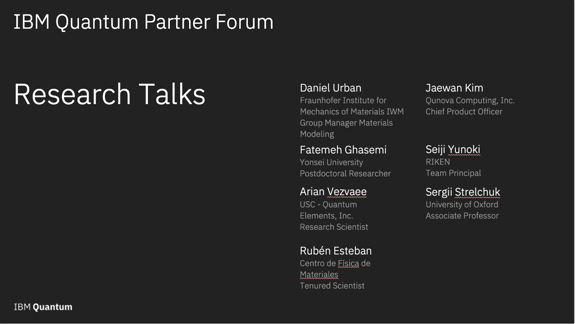
Research Talks
About This Webcast
Insights from across the quantum landscape on where different domains are making meaningful strides toward advantage Speakers: Danel Urban, Group Manager Materials Modeling, Fraunhofer-Institut fur Werkstoffmechanik IWM Title: Perspectives of Quantum Computing for Material Simulations Abstract: Quantum computers (QC) offer the possibility for efficient simulations of the electronic system of solids, which determines their structure, electrical and optical properties. While classical methods, which are typically based on mean-field approximations, fail, when the individual interactions between electrons are strong, a QC in principle allows to simulate these interactions explicitly even for systems of many electrons. We demonstrate our hybrid quantum-classical workflow for this type of material simulations, which may be applied for the modelling of ion-battery or fuel-cell materials. Starting from atomistic simulation by means of density functional theory (DFT), an efficient model system is extracted, which consists of an interacting subspace of effective orbitals, which is treated within dynamical mean field theory (DMFT). We describe how this model may be solved on IBM QC hardware, and we investigate the influence of statistical noise and different types of hardware noise. We quantify the requirements for quantum computing hardware needed to obtain a quantum advantage in the future. Jaewan Kim, COO, Qunova Computing Inc. Title: Realizing Industrial Quantum Advantage: Chemical Accuracy at Scale with Qunova Computing Abstract: As the quantum industry shifts toward tangible commercial value, Qunova Computing is bridging the gap to Industrial Quantum Advantage through its breakthrough Handover Iteration Variational Quantum Eigensolver (HI-VQE). Now integrated into the IBM Qiskit Functions Catalog, our technology enables chemical accuracy (below 1.6 mHa) on IBM Quantum hardware while reducing computational resource requirements. This talk demonstrates how Qunova’s technology is transforming R&D across pharmaceuticals, battery technology, and material science, offering IBM partners a validated pathway to high-fidelity virtual discovery today. Fatemeh Ghasemi, Postdoc Researcher, Yonsei Researcher Title: Hybrid Quantum Algorithms for Computational Chemistry: A Clear Advance toward Quantum Advantage Abstract: Accurately capturing electron correlation in large-scale molecular systems remains one of the foremost challenges in quantum chemistry and a primary driver for the development of quantum algorithms. Overcoming this limitation is central to realizing the promise of quantum computing in chemistry. We investigate the pyridine–Li⁺ complex using three quantum algorithms: the variational quantum eigensolver (VQE), the subspace quantum diagonalization (SQD) method, and the recently introduced handover iterative VQE (HI-VQE). Our results demonstrate how new generations of hybrid quantum–classical frameworks overcome the scalability and noise sensitivity that constrain conventional VQE approaches. SQD and HI-VQE achieve ground-state energy calculations for problem sizes inaccessible to classical computation, marking a clear advance toward quantum advantage. Arian Vezvaee, Quantum Research Scientist, University of Southern California Title: Quantum Error Correction And Dynamical Decoupling: Better Together Abstract: We present results from the latest USC–IBM QIC experiments showing that combining quantum error correction with dynamical decoupling can protect logical qubits better than either method alone. By tailoring pulses to the logical-level structure of the code, logical error channels are suppressed while QEC handles detectable or correctable physical errors, enabling higher-fidelity logical states, improved surface code performance, and progress toward practical fault-tolerant quantum computing. Seiji Yunoki, Team Principal, RIKEN Title: Digital Quantum Simulation of Long-Time Many-Body Dynamics in Two Dimensions Abstract: Digital quantum processors are emerging as powerful experimental platforms for studying nonequilibrium many-body dynamics beyond the practical reach of classical simulations. In this talk, I will present our recent study of quasiperiodic Floquet Ising dynamics on IBM superconducting quantum processors, focusing on two-dimensional experiments performed on the 156-qubit Heron processor, ibm_kobe [1]. Using hardware-native fractional gates, we realized deep Floquet circuits with up to 5000 cycles, approximately 50 times longer than previous quantum-computing experiments in comparable settings. These long-time experiments reveal clear signatures of an ergodic–many-body-localized crossover. In the strong quasiperiodic-potential regime, autocorrelation functions show persistent memory of the initial state, while the quantum Fisher information grows approximately logarithmically over thousands of Floquet cycles, providing experimental evidence for slow entanglement spreading consistent with many-body localization in two dimensions. Tensor-network simulations show reasonable agreement with the quantum hardware data up to about 100 cycles, but simulations beyond 1000 cycles become impractical in terms of both accuracy and computational time. Our results highlight a practical quantum advantage in using programmable quantum processors to explore long-time two-dimensional many-body dynamics. [1] K. Nagao, T. Shirakawam R.-Y. Sun, P. Prelovsek, and S. Yunoki, “Probing many-body localization crossover in quasiperiodic Floquet circuits on a quantum processor”, arXiv:2503.12575. Rubén Esteban, Researcher, Centro de Física de Materiales (CFM-MPC), CSIC-EHU Title: Including dissipation in utility-scale quantum experiments of the dynamics of interacting qubits Abstract: The study of physical systems with quantum computation typically focuses on the unitary response, without including dissipation processes that are unavoidable in practice. Here, we demonstrate that hardware-aware quantum dynamical circuits can capture the collective dissipative time evolution of large qubits chains, representing, for example, quantum emitters coupled to optical nanoresonators or optical waveguides. The decay of individual qubits as well as, crucially, collective dissipative coupling between the qubits are included through the use of ancilla qubits. We use an IBM quantum processor Heron r2 to perform quantum experiments including up to a total of 129 qubits (86 qubits corresponding to the system and 43 to the ancillas) and about 3800 2-qubit gates. Further, to assess the accuracy of the results, we develop a classical Monte Carlo–Time-Evolving Block-Decimation (MC-TEBD) tensor-network method. The results obtained with this method corroborate that quantum experiments are able to reproduce the dynamics of the system, a significant advance towards the use of quantum computing to study complex phenomena in the presence of dissipation. Sergii Strelchuk, Associate Professor, University of Oxford Title: Scaling Quantum Pangenomics: From Sequence Assembly to the First Whole-Genome Encoding Abstract: Genomics has transformed our understanding of biology and disease, and pangenomics — the study of variation across many genomes simultaneously — is the natural next step toward decoding how genetic diversity shapes human health. Building and analysing pangenomes, however, gives rise to computational problems that are notoriously hard for classical algorithms, making them a natural target for quantum computing.Working within the Wellcome Leap Quantum for Bio (Q4Bio) programme, our consortium, led from Oxford together with the Wellcome Sanger Institute and Cambridge, has spent the past phase running real pangenomic workloads on IBM Quantum hardware. In this talk I will share two of our recent achievements on IBM hardware. First, we recast pangenome-guided sequence assembly as a quantum optimisation problem, with the algorithm successfully recovering optimal assemblies. Second, and, to our knowledge, a world-first, we encoded the complete genome of an organism, the Hepatitis-D virus, onto a real quantum computer, alongside a fragment of the SARS-CoV-2 spike-protein gene, sending a clear signal to the life-sciences community about the growing reach of current and emerging quantum hardware.
Speakers
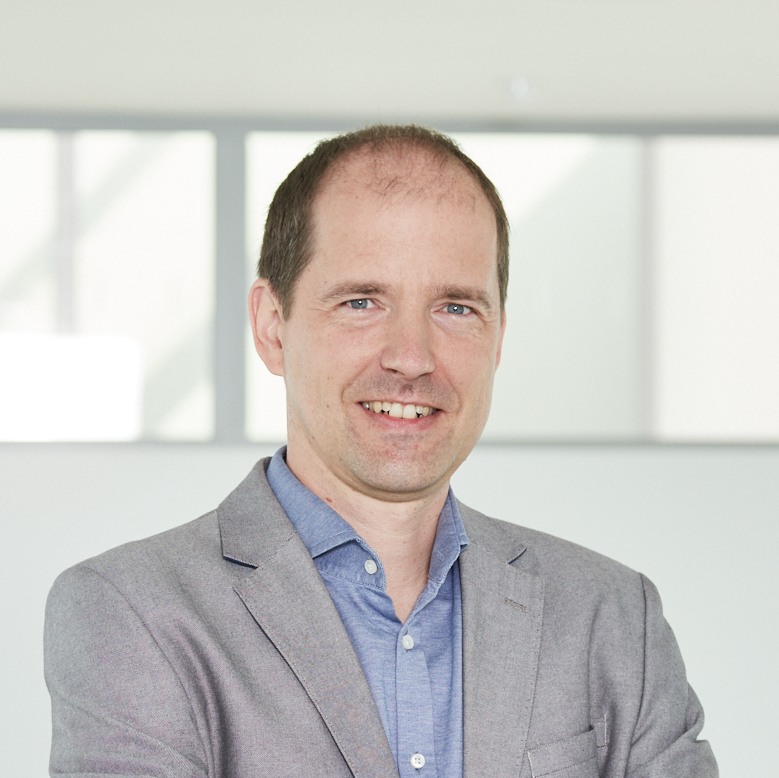
Daniel Urban
Group Manager Materials Modeling , Fraunhofer-Institut fur Werkstoffmechanik IWM
Daniel Urban studied Physics in Freiburg and Paris and got his PhD 2006 in theoretical solid state physics at the University of Freiburg. As a postdoc researcher in Freiburg, Tucson, and Madrid in the following years, he contributed to the understanding of nanoscopic systems, some of which are at the basis of current quantum technology and quantum computing devices. In 2012 he joined the Fraunhofer institute for mechanics of materials IWM, and since 2018 he heads the materials modelling group. His current research focuses on the atomistic modelling of functional materials and on the development of hybrid classical/quantum computing approaches for the simulation of materials for energy storage and conversion.
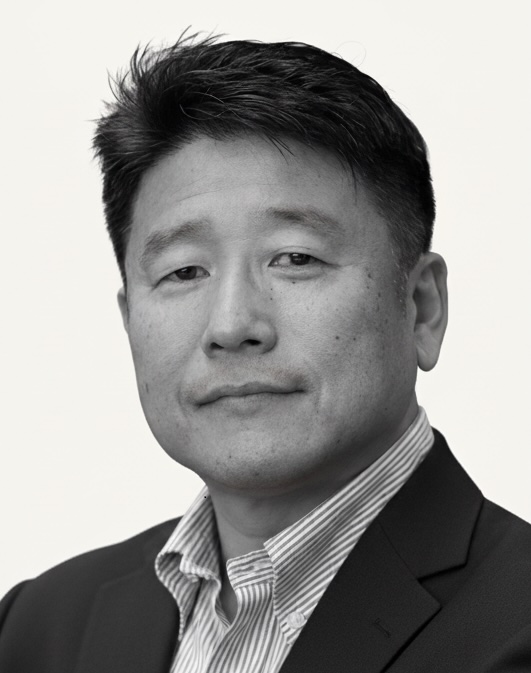
Jaewan Kim
Chief Product Officer , Qunova Computing, Inc.
Seoul National University, BA in Physics University of Florida, PhD in Theoretical Physics Bloomberg LP, Engineering Manager Amazon.com Inc., Senior Product and Engineering Leader Qunova Computing, Inc Chief Product Officer

Fatemah Ghasemi
Postdoctoral Researcher , Yonsei University
She is currently a postdoctoral researcher at Yonsei University since 2023. Her current work focuses on the application of quantum computing algorithms to problems in chemistry and biology. She earned her Ph.D. in Physical Chemistry from Sharif University of Technology, where her research focused on open quantum systems and quantum biology. Following her doctoral studies, she continued her research as a postdoctoral researcher in the field of quantum biology for one year. Her research interests span quantum chemistry, computational modeling, and energy-related materials. During her B.Sc. and M.Sc. studies, she gained experience with a wide range of computational chemistry methods and techniques, particularly in electronic structure calculations and molecular modeling.
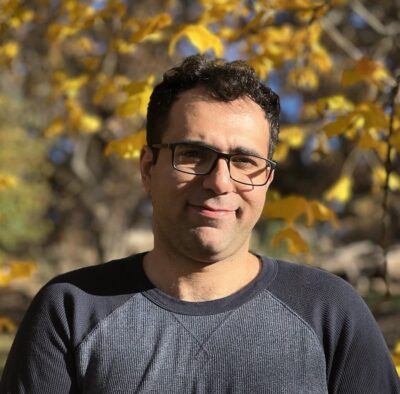
Arian Vezvaee
Research Scientist , USC - Quantum Elements, Inc.
Arian Vezvaee is a quantum research scientist at Quantum Elements with a joint appointment at the University of Southern California. He earned his Ph.D. from Virginia Tech in 2021, where his research focused on quantum device design. His current work lies at the intersection of superconducting quantum devices and quantum error correction, with an emphasis on addressing device-level challenges that support the implementation of diverse error-correction codes.
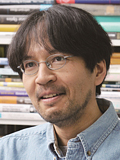
Seiji Yunoki
Team Principal , RIKEN
Seiji Yunoki is a Chief Scientist at RIKEN, where he leads research teams across four research centers (RIKEN Pioneering Research Institute, RIKEN Center for Computational Science, RIKEN Center for Emergent Matter Science, and RIKEN Center for Quantum Computing). After earning his Ph.D from Nagoya University in 1996, he held research positions in the USA, the Netherlands, and Italy before joining RIKEN in 2008. His current research focuses on quantum computing and its applications in condensed matter physics.
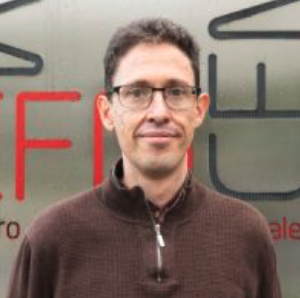
Rubén Esteban
Tenured Scientist , Centro de Física de Materiales (CFM-MPC), CSIC-UPV/EHU
Rubén Esteban is a tenured scientist in the Centro de Física de Materiales (CFM) of the Centro Superior de Investigaciones Científicas (CSIC) in San Sebastián. He obtained his PhD at the EPFL (Switzerland) in 2007, for work performed at the Max Planck Institute for Solid State Research in Stuttgart (Germany) with Klaus Kern and Ralf Vogelgesang. The main topic of the work of Ruben Esteban focuses on the properties of optical nanoresonators and their coupling with quantum emitters. Ruben Esteban is interested in the application of quantum computers to model these and other physical systems.
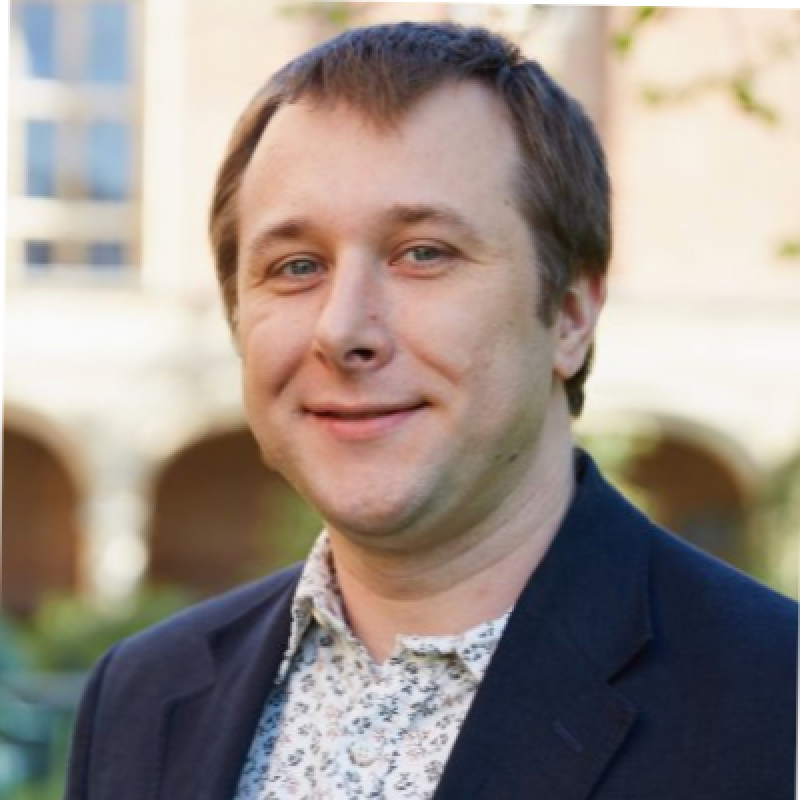
Sergii Strelchuk
Associate Professor , University of Oxford
Sergii Strelchuk is an Associate Professor of Computer Science at the University of Oxford and a Tutorial Fellow at Jesus College. His research lies at the interface of quantum computation, quantum information theory, algorithms, and mathematical physics, with current interests including quantum algorithms and applications in bioinformatics, classical simulation methods, quantum complexity theory, and quantum learning theory. He leads major research programmes on quantum pangenomics, robust and reliable quantum computing, and quantum algorithms for quantum field theory. Before joining Oxford, he held fellowships and research positions at the University of Cambridge, including a Royal Society University Research Fellowship at DAMTP, and completed his PhD in Quantum Information Theory at Cambridge.