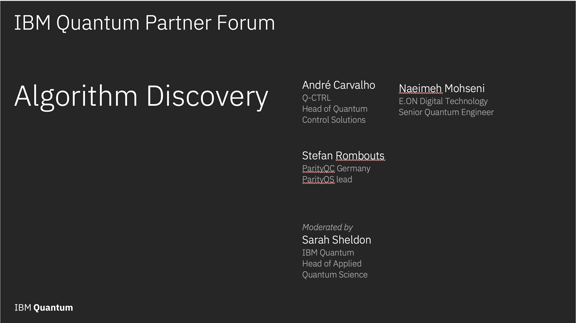
Algorithm Discovery
About This Webcast
Insights into the evolving landscape of quantum algorithm research and the momentum building across the field Speakers: Sarah Sheldon, Head of Applied Quantum Science, Principal Research Scientist, IBM André Carvalho, Head of Quantum Control Solutions, Q-CTRL Title : Practical quantum advantage in materials simulation Abstract: Using an IBM quantum computer and a specially designed compiler and error-suppression toolchain, we ran an algorithm using 120 qubits and over 10,000 two-qubit quantum-logic operations, simulating a Fermionic system with up to 60 interacting electrons. These simulations are beyond the reach of exact state vector simulations and achieved practical quantum advantage with a factor of 3,000 quantum improvement in time to solution when compared to state-of-the-art classical methods. Naeimeh Mosheni, Quantum Scientist, E.ON Title: Enhanced QAOA for Constrained Optimization: Application to Unit Commitment Abstract: Constrained combinatorial optimization problems are challenging for quantum computing, particularly at utility scale and on near-term hardware. At the same time, these problems are of significant practical importance in industry. For example, the Unit Commitment (UC) problem in energy systems involves complex operational constraints. As interest grows in leveraging quantum computing for industrial optimization, there is a need for quantum algorithms that can efficiently handle constraints while scaling to practically relevant problem sizes. In this work, we apply copula-QAOA (cop-QAOA), a hardware-efficient approach for constrained optimization, to a single-period UC problem that can be reduced to a one-dimensional knapsack problem. Cop-QAOA biases the quantum state toward feasible solutions using constant-depth mixers and appropriately biased initial states. We benchmark the method on problem instances that are confirmed to be hard for classical solvers such as Gurobi. Our results show that cop-QAOA often finds solutions better than a lazy greedy baseline and very close to those obtained by Gurobi, using only a few QAOA rounds. This work presents the largest successful demonstration of the knapsack problem on IBM Quantum hardware using up to 150 qubits, and more generally, the largest demonstration of constrained combinatorial optimization in which constraints are enforced through shallow mixers. Stefan Rombouts, ParityOS Lead, Parity Quantum Computing Title: Demonstrating Record Fidelity for the Quantum Fourier Transform Abstract: By moving beyond traditional swap-based methods, the ParityQC Architecture enables a super-exponential scaling advantage for the process fidelity of the Quantum Fourier Transform. We have validated this approach on the IBM Heron r3 chip, reaching record fidelities for QFT circuits of up to 50 qubits. Other quantum algorithms, like QAOA or fermionic Hamiltonian propagators, might benefit from similar circuit optimizations.
Speakers

Sarah Sheldon
Head of Applied Quantum Science , IBM
Sarah Sheldon is a principal research scientist and the head of applied quantum science at IBM Quantum. She received her Ph.D. in nuclear science and engineering from MIT in 2013, where she studied quantum control techniques. She then joined IBM and has done research on improving gate calibrations in superconducting qubits, developing techniques for characterizing quantum devices, and extending the capabilities of current quantum systems. Her team now focuses on developing novel algorithms and applications with quantum computing.
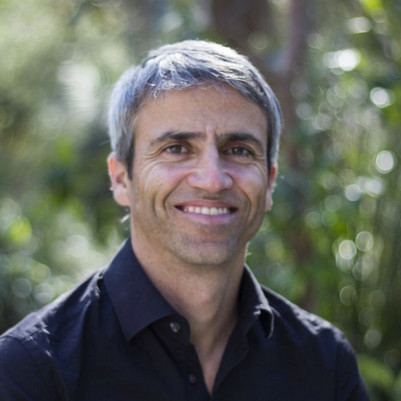
André Carvalho
Head of Quantum Control Solutions , Q-CTRL
Andre Carvalho is the Head of Quantum Control Solutions at Q-CTRL, where he leads all aspects of customer-related projects. With a PhD in physics and more than 20 years working as a researcher, Andre has a vast international experience and is widely recognized for his contributions to the fields of quantum information and quantum control. At Q-CTRL, he is bringing together expertise from physicists and engineers to develop quantum computing solutions for high-value end user applications.
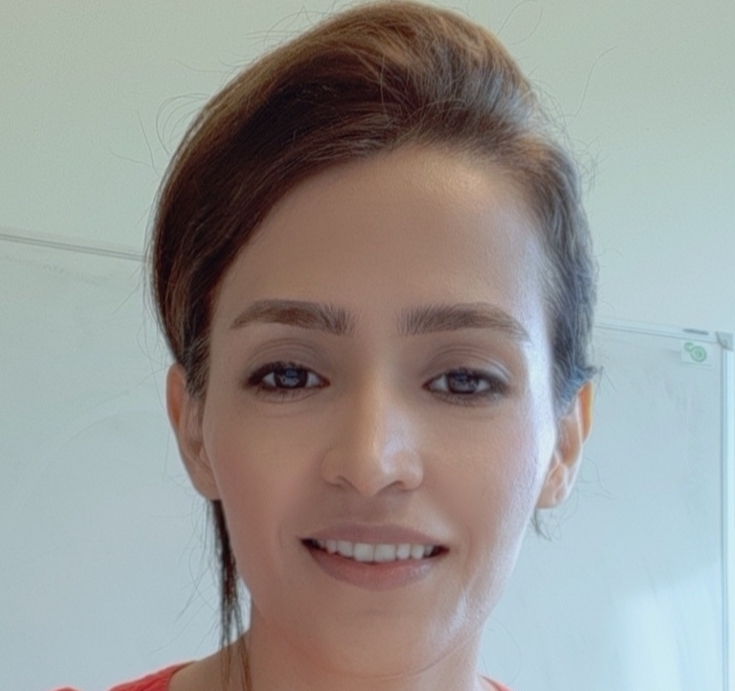
Naeimeh Mohseni
Senior Researcher , E.ON Digital Technology GmbH
I completed my PhD in 2019, focusing on quantum metrology, quantum computing, and error mitigation. I then held a postdoctoral position at the Max Planck Institute for the Science of Light, where I worked at the interface of quantum many-body dynamics and machine learning. Since 2023, I have been working as a Researcher at E.ON Digital Technology, focusing on quantum computing.
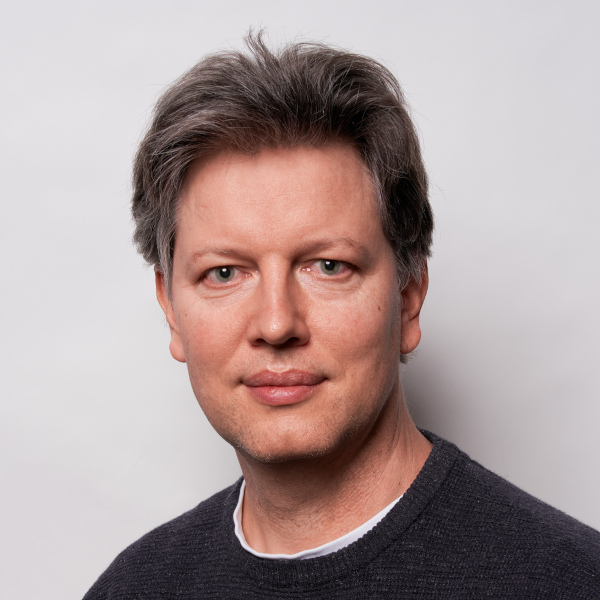
Stefan Rombouts
ParityOS Lead , ParityQC Germany
Computational physicist, quantum computing engineer, leading the quantum software development at ParityQC Germany.