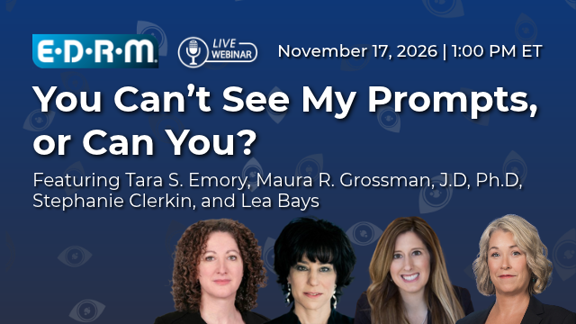
You Can’t See My Prompts, or Can You?
About This Webcast
When parties use generative AI (GenAI) to review documents in eDiscovery, should they be required to disclose the prompts that guided the review? Are those prompts analogous to search terms, which are typically disclosed, or are they more like TAR training sets or documents selected to prepare a witness for testimony, which may be protected as attorney work product? In a recent article, panelists Tara S. Emory and Maura R. Grossman argue that prompts used in GenAI-assisted TAR review should generally be protected from disclosure, except when they merely replicate requests for production (RFPs) or when there is evidence of a material deficiency in the production or attorney misconduct. But is that the right balance between transparency/cooperation and work-product protection? And what are the implications for the defensibility of GenAI-assisted TAR review? Join four eDiscovery experts for a lively discussion of the legal, technical, and practical considerations surrounding GenAI prompt disclosure. Expect differing perspectives—and perhaps some spirited debate.
Speakers

Tara S. Emory
Principal , Aligned Discovery PLLC
Tara is Principal at Aligned Discovery PLLC and serves as a court-appointed neutral, helping parties and judges navigate high-stakes discovery and technology-related disputes. An experienced legal technology lawyer, Tara specializes in the intersection of AI, complex eDiscovery, and practical problem solving. She also focuses on the practical applications of AI within legal workflows, including the development of AI processes and defensible technology applications and workflows. Tara is a Steering Committee member of The Sedona Conference WG13 on AI and the Law, a Board Member of the Academy of Court-Appointed Neutrals, a Chambers-ranked individual in eDiscovery, a certified mediator, and a frequent participant in leading industry advisory groups.
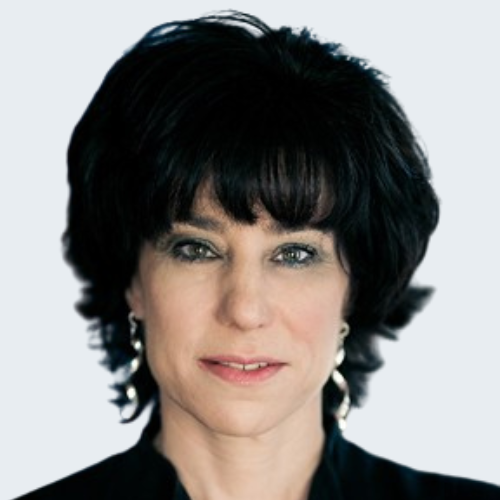
Maura R. Grossman, J.D., Ph.D.
Research Professor and eDiscovery Lawyer/Consultant/Expert/Special Master , University of Waterloo, Ontario, Canada
Maura R. Grossman, J.D., Ph.D., is a Research Professor in the School of Computer Science, cross-appointed to the School of Public Health Sciences, at the University of Waterloo; an Adjunct Professor at Osgoode Hall Law School of York University; and an affiliate faculty member at the Vector Institute of Artificial Intelligence, all in Ontario, Canada. She is also Principal at Maura Grossman Law, an eDiscovery law and consulting firm in Buffalo, New York, U.S.A. Maura has been widely recognized for her scholarly work evaluating the application of machine-learning technologies (i.e., technology-assisted review or TAR) in the fields of law, government archives, and healthcare. Her studies have frequently been cited in the case law and literature, in North America and abroad. More recently, Maura’s scholarship has focused on responsible Artificial Intelligence (RAI) and AI as evidence. Maura is also well known for her appointments as a special master and/or as an expert in many high-profile U.S. federal and state court cases. In addition to her J.D. from the Georgetown University Law Center, Maura also holds M.A. and Ph.D. degrees in Psychology from the Derner Institute of Adelphi University.

Stephanie Clerkin
Director of Litigation Support , Korein Tillery
Stephanie is the Director of Litigation Support at Korein Tillery, one of the country’s leading plaintiffs’ complex-litigation firms, where she leverages over 20 years of experience in finance, consulting, and data analytics to manage massive litigation projects, as well as the firm’s eDiscovery platform. Working with all departments in the firm, she understands how to bridge the gap between the legal teams and IT personnel to streamline discovery efforts and design cost-effective solutions for clients. She is responsible for processing, analyzing, reviewing, and producing hundreds of terabytes of ESI. Stephanie is an ACEDS Certified e-Discovery Specialist and Relativity Master. She is a Member Liaison for the St. Louis ILTA Community and the current Strategic Partner Liaison for ILTA and Relativity. She is also an EDRM 2.0 Co-Project Trustee and a member of Women in eDiscovery and The Sedona Conference. She serves on the Steering Committee for the St. Louis Relativity User Group. Outside the office, she tirelessly dedicates countless hours to several community organizations, including the Make-A-Wish® Foundation.

Lea Bays
Partner , Robbins Geller Rudman & Dowd
Lea Malani Bays is a Partner at Robbins Geller Rudman & Dowd in San Diego. Robbins Geller Rudman & Dowd specializes in representing plaintiffs in complex securities fraud, antitrust, and consumer protection litigation. Lea currently focuses on the firm’s electronic discovery issues from preservation through production and efficient analysis of incoming productions. She is familiar with best practices for the various stages of electronic discovery, including identification of relevant electronically stored information, data culling, search protocols and predictive coding protocols, privilege and responsiveness reviews. Lea also has also has experience in post-production discovery through trial preparation for a wide range of litigation.