Robotics and ROS 2 in the PolarFire® SoC FPGA
About This Webcast
Robotics is the art of real-time system integration. Robots are deterministic machines that essentially meet computation deadlines. Robot brains (and robot behaviors) take the form of computational graphs, with data flowing between computation nodes and across physical networks (communication buses) while mapping to underlying sensors and actuators. The popular choice for building these computational graphs for robots is the Robot Operating System (ROS), a framework for robot application development. ROS is the common language in robotics, with hundreds of companies and thousands of developers using it every day. Most companies that build robots today use ROS or similar event-driven software frameworks. We have collaborated with Acceleration Robotics to integrate ROS 2 in the PolarFire® SoC FPGA. In this talk, Víctor Mayoral-Vilches from Acceleration Robotics will discuss the results of our joint effort to enable the latest ROS 2 distribution (Humble Hawksbill) in the PolarFire® SoC boards as an extension of the Yocto Board Support Package (BSP) that we offer. He will explain the basic principles of ROS 2 and the process required to enable ROS 2 with the official BSP. Víctor will also discuss how most roboticists today build ROS graphs in a CPU-centric manner. These CPUs have memory-centric architectures that limit the performance and determinism. He will then wrap up the presentation with a robotics case study that shows how FPGA SoC solutions, such as the PolarFire SoC, can leverage acceleration kernels within the FPGA fabric to achieve additional performance and determinism at a lower power ratio.
Speakers

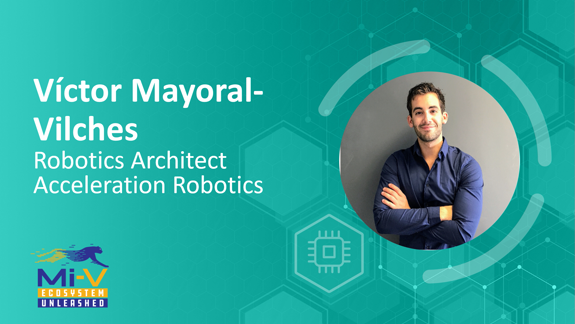
Víctor Mayoral-Vilches
Robotics Architect , Acceleration Robotics
Strong technical background and one of the top experts globally on ROS 2. Spent the last 10 years building robots. Founded, funded and led 4 robotics startups generating more than 100 person-year positions in robotics. More than 25 scientific publications and 10 patents filed, mostly in the fields of secure and reconfigurable hardware and software for robots.