Multidisciplinary management of MASLD–MASH: bridging diabetology and hepatology
About This Webcast
Key messages Tiered Fibrosis Screening: Screen high-risk groups (type 2 diabetes, obesity, abnormal platelets or splenomegaly) using a two-tier approach: start with FIB-4 in primary care, then confirm with elastography (FibroScan or ultrasound elastography) to detect advanced fibrosis early. Ultrasound Isn’t Enough: Don’t trust a “normal” ultrasound to rule out fibrosis or compensated cirrhosis; rely on noninvasive fibrosis tools (liver stiffness <8 kPa rules out advanced fibrosis; CAP ≥288 dB/m indicates steatosis) and repeat tests when results are borderline or inconsistent. Cardio-Metabolic MASLD Management: Manage MASLD beyond the liver: aggressively treat cardiovascular risk with statins (even with mild ALT rise), promote daily physical activity and Mediterranean-style diet, reduce sugars and saturated fats, and consider semaglutide in F2–F3 for histologic benefit and cardio-metabolic gains. Smart Cirrhosis Stratification: In compensated cirrhosis, use liver stiffness and platelets annually to gauge portal hypertension, skip endoscopy when LS <20 kPa with normal platelets, prefer carvedilol to prevent decompensation (titrate low, effective ceiling ~12.5 mg), and use spleen stiffness (~≥40 kPa) to refine gray-zone decisions. Genetic Steatosis Red Flags: Watch for special genetic red flags: very low untreated LDL (<55 mg/dL/1.4 mmol/L) with steatosis suggests APOB mutations that markedly raise cirrhosis/HCC risk—confirm with imaging/elastography and family assessment to guide close follow-up.
Speakers

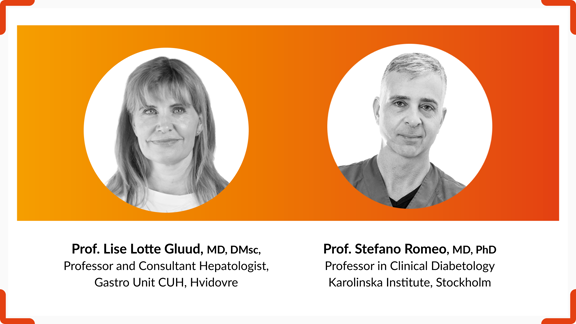
Prof. Lise Lotte Gluud
MD, DMsc, Professor and Consultant Hepatologist , Gastro Unit Copenhagen University Hospital, Hvidovre

Prof. Stefano Romeo
MD, PhD, Professor in Clinical Diabetology , Karolinska Institute, Stockholm